THE ENDOCANNABINOID SYSTEM

create your own web page

CANNABASICS - THE ENDOCANNABINOID SYSTEM

Mobirise

The Human Endocannabinoid System

Named after the plant that led to its discovery, the Endocannabinoid System is the physiological system that establishes and maintains human health. Each tissue and organ in the human body has its own Endocannabinoid receptors. It is the responsibility of these receptors when activated is to maintain homeostasis. The definition of Homeostasis according to the freedictionary - The tendency of an organism or cell to regulate the chemical processes that take place internally so as to maintain health and functioning, regardless of outside conditions. The body’s internal balance, produced by a regulatory system that maintains more or less stable temperature, blood pressure, electrolyte levels are examples of homeostasis. 

Cannabinoids (broad name for Endocannabinoids and Phytocannabinoids) promote homeostasis at every level of biological life, from sub‐cellular to organism.

The discovery of the Endocannabinoid System was the result of in-depth investigation into why THC (Tetrahydrocannabinol) had such profound effects on the human body. In 1980, 20 years after the discovery of THC, scientist finally discovered the Endocannabinoid System. One of the body’s largest neurotransmitter networks, it is made up of messengers and receptors. The messengers seek out and bind with active receptor sites where they then assist with reducing inflammation, anxiety and other problems. Non-active receptors are healthy so they don’t need repairing.


And now things get a little more complicated. The messengers are naturally produced neuro-modulatory lipids called Endocannabinoids. The receptors for these messengers are called Cannabinoid-1 and Cannabinoid-2 receptors or CB1 & CB2 for short. The Endocannabinoid molecules are called Anandamide and 2-arachidonoylglycerol or 2-AG, and can be found in the brain, organs, connective tissues, glands and immune cells. Anandamide and 2-arachidonoylglycerol are synthesised on demand or when required from the phospholipid precursors in cell membranes. When Anandamide and 2-AG bind to the receptors (CB1 & CB2 receptors), besides telling the affected area how to feel and how to act, they also regulate other bodily systems such as the immune, nervous and gastrointestinal systems.

So how does this system actually work?

The Endocannabinoid System is responsible for homeostasis or balance. Accordingly, it sends neurotransmitters (messengers with communication molecules) to every part of the human body to check if everything is functioning efficiently and whether anything needs rebalancing. When an issue is identified, it acts to regulate it by sending further instructions to receptors that adjust how you feel and think.

Research has identified several areas over which the Endocannabinoid system keeps a watchful eye, including:

  1. Fertility, pregnancy, and reproductive systems
  2. Appetite, hunger, and digestive systems operations
  3. Sleep,
  4. Motor control,
  5. Pain and pleasure,
  6. Immune function,
  7. Mood and  Memory.
Researchers believe that the underlying cause of many ailments, and particularly those related to the immune, gastrointestinal, central and peripheral nervous, reproductive and digestive systems are the result of Endocannabinoid Deficiency.

Endocannabinoid Deficiency

Endocannabinoid Deficiency is the theory that ailments and illness develop when the body’s Endocannabinoid System isn’t functioning properly or when the body doesn’t produce enough Endocannabinoids or receptors. As a result, the body becomes unbalanced and vulnerable to illness or disease.

In his 2004 study Neuro Endocrinology Letters, Dr Ethan Russo, a renowned cannabinoid researcher, suggested that deficient cannabinoid levels could be behind the development of certain medical conditions. To this end, he said that the supplementation of Phytocannabinoids such as those found in plants like Cannabis were proving to be effective at alleviating a range of conditions including multiple sclerosis, Parkinson’s, migraine, fibromyalgia, IBS (irritable bowel syndrome) and related conditions, and depression. These, he said, displayed common clinical, biochemical and pathophysiological patterns that suggested an underlying clinical Endocannabinoid deficiency which could be treated with cannabinoid medicines.
Further, Dr Russo maintained that cannabinoids from Cannabis plants were essential nutrients able to minimize certain diseases by assisting Endocannabinoid System functionality.

Cannabinoid Receptors

Cannabinoid Receptor 1 (CB1) 

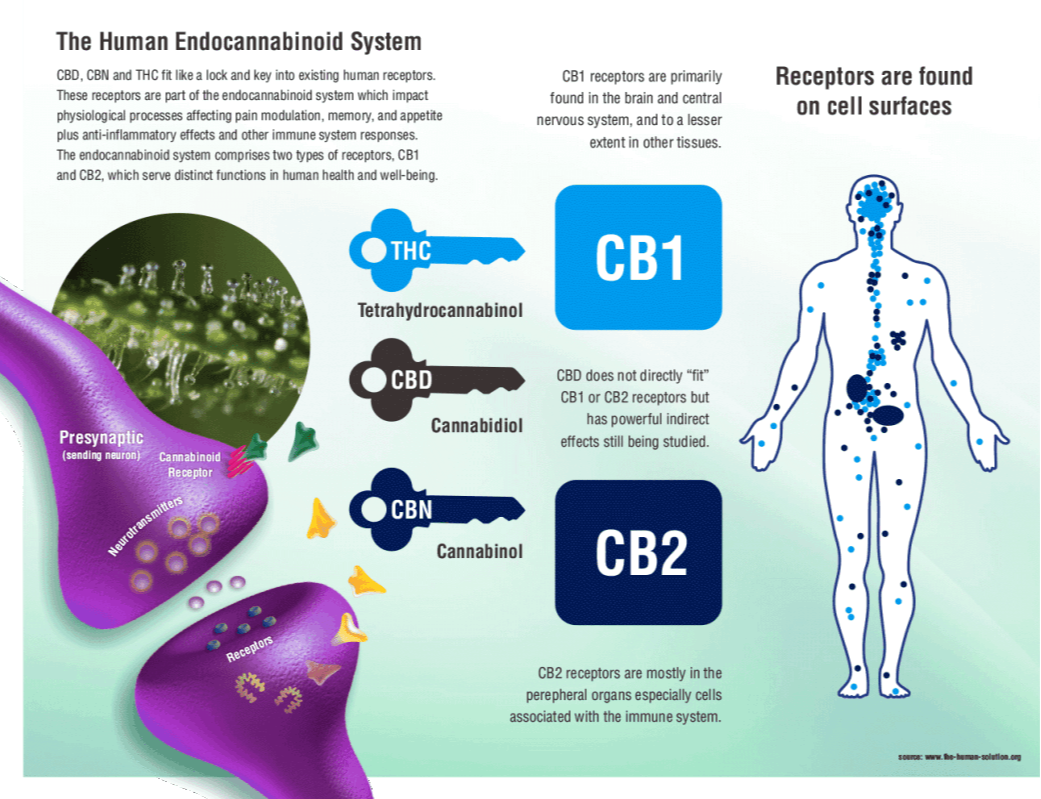
Cannabinoid Receptor 1 (CB1) - are primarily located on nerve cells in the brain, spinal cord and central nervous system. They are also found in peripheral organs and tissues such as the lungs, liver, kidneys, spleen, white blood cells, endocrine glands and parts of the reproductive, gastrointestinal and urinary tracts.

In the brain, CB1 receptors are abundant in the cerebellum, basal ganglia, hippocampus and dorsal-primary afferent spinal cord regions. That’s why cannabinoids are effective for memory processing, pain regulation and motor control. In the brain stem, the concentration of cannabinoids is low, which may be why Cannabis use is not associated with sudden death resulting from depressed respiration, as is the case with heroin overdoses - no one in the history of Cannabis usage has ever died from an overdose.

Our natural Endocannabinoids and Phytocannabinoids such as THC bind with CB1 receptors as a result of their similar molecular structure. This gives patients relief from pain, nausea and depression, bringing in better sleep among other conditions.

CB1 receptors are activated by the Endocannabinoid neurotransmitters anandamide and 2arachidonoylglycerol, and by plant-based cannabinoids such as THC.

Stimulation of the CB1 receptor results in people getting high. It also promotes increased appetite, mood elevation, stimulation of thought and creativity, enhanced sensory sensitivity, better pain management, better movement coordination and fertility.

Cannabinoid Receptor 2 (CB2)

Cannabinoid Receptor 2 (CB2) – receptors are found mainly in the immune system, with a heavy concentration in the spleen and the gastrointestinal system. In the immune system, one important function of the cannabinoid receptors is the regulation of cytokine release. The presence of CB2 receptor on macrophage cells is indicative of its ability to bring the cannabinoid compound to the site to assist in fighting disease, reducing inflammation and alleviating pain. Selective CB2 receptor agonists are accordingly becoming increasingly popular subjects of research as a result of their potential anti-inflammatory and anti-cancer effects. 

How cannabinoid receptors work

Cannabinoids and their receptors are essentially like locks and keys. Only keys specific to a lock will open that lock, which is why Cannabinoids are often referred to as the ‘KEY’, and the CB1 / CB2 receptors as the ‘LOCKS’. When you take Cannabis oil, the Phytocannabinoids (keys) search the body for their locks.  

Research has also revealed that the Endocannabinoid System uses “backward” communication. It’s this type of communication that reduces 

inflammation, lowers blood pressure, inhibits immune response and relaxes overly-stimulated nerves. Produced on demand, these Endocannabinoids are released when the body is out of balance. So, whether the reason for the imbalance is the result of an overproduction of an enzyme, protein or an overexpression of receptors, if the ECS isn’t functioning correctly, the body has a difficult time regulating emotions, appetite, memory and everything else for which the ECS is responsible.

© Cannaheal PTY LTD (2018/376454/07) - 2019 All Rights Reserved


THIS MEDICINE HAS NOT BEEN EVALUATED BY THE MCC.
THIS MEDICINE IS NOT INTENDED TO DIAGNOSE OR PREVENT ANY DISEASE